
Ancient Kennel
About Us

Ancient Kennel is located in Stockholm County, and is currently the first and only Swedish Kennel Club (SKK)-affiliated breeder of Alaskan Klee Kai in Sweden.
Behind the kennel is a long-standing interest in canine behaviour, training, and understanding dogs as individuals, which over time has grown into a strong commitment to genetics, temperament, and long-term breed development.
Today, much of our work revolves around the Alaskan Klee Kai. Our involvement extends beyond breeding to active breed development and efforts to support the breed’s future in Sweden. We also founded the Swedish Alaskan Klee Kai Club (SAKK) and remain engaged in matters concerning the breed’s development and long-term sustainability.
For us, breeding is not about producing puppies, but about contributing to healthy dogs with stable temperaments, good quality of life, and sustainable genetic diversity over time. Health, function, temperament, and genetic diversity are prioritised over colour, trends, or short-term goals.
Breedings are planned only when there is a clear purpose behind the combination. Repeat pairings are avoided whenever possible unless there are specific reasons to do so, such as preserving valuable traits or important genetic diversity within the breed.
Significant emphasis is placed on research, documentation, and genetic analysis, with breeding decisions guided by available evidence and knowledge rather than tradition or assumptions whenever possible.
Our dogs live alongside us as part of everyday family life, and our puppies are raised in a home environment with a focus on confidence, independence, and positive early experiences during their first weeks of life.
We also collaborate with House of Klee Kai, an international network of breeders committed to health, temperament, and the long-term stewardship of the breed’s future.
About Puppy Culture

Our puppies are raised using Puppy Culture, a puppy-rearing program developed by Jane Killion and based on modern knowledge of canine development, learning, and behaviour. The program focuses on a puppy’s early experiences during the first weeks of life, when environment, handling, and positive exposure can have a lasting influence on how the dog later interacts with the world.
The goal is to provide each puppy with a strong foundation for confidence, resilience, curiosity, and effective communication.
Our puppies receive age-appropriate experiences tailored to the individual, including:
-
Different surfaces, sounds, and environments
-
Handling of the body, paws, nails, and routine examinations
-
Problem-solving and independent thinking
-
Social situations and recovery after new experiences
-
Recall, engagement, and basic training exercises through play
-
Car travel, everyday environments, and daily routines
-
Positive exposure to situations they may encounter later in life
We follow each puppy’s development rather than a strict schedule, as development varies between individuals and litters. Fear periods and the puppy’s own confidence are always taken into account.

About Alaskan Klee Kai

The Alaskan Klee Kai, often simply called Klee Kai (pronounced klee kai), is a small Nordic spitz breed developed in Alaska during the 1970s by Linda Spurlin. The goal was to create a smaller companion dog that retained the northern appearance of larger sled-dog, without extreme proportions or dwarfism.
Despite its origins, the Alaskan Klee Kai was primarily developed as an active companion breed and generally thrives in homes that provide both physical exercise and mental enrichment. What this looks like varies between individuals and families, but may include activities such as trick training, nosework, hiking, agility, rally obedience, or other canine sports.
The breed is often described as intelligent, observant, and deeply devoted to its family, while many individuals can be somewhat reserved around strangers. The Alaskan Klee Kai is also known for being highly vocal and expressive, often communicating through “talking,” howling, grumbling, and other unique sounds accompanied by clear body language. Traditional barking may occur, but many owners find these alternative forms of vocalization to be more characteristic of the breed.

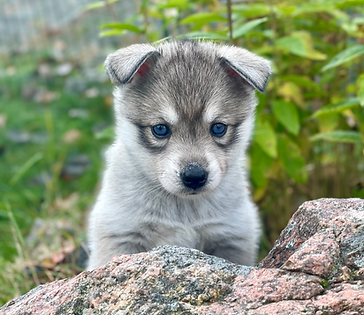
The Alaskan Klee Kai is known for its northern, wolf-like appearance, erect ears, well-carried tail, and distinctive facial mask. The breed is genetically domino-patterned, contributing to its characteristic contrast and expression. Coat colours are most commonly black, grey, red, or brown with white, and all eye colours may occur, including blue, brown, and heterochromia. Solid white coats can occur but are recessive and considered disqualifying under the breed standard. As the gene can be identified through DNA testing, it is actively managed within responsible breeding programs.
Most Alaskan Klee Kai have a medium-length double coat, though a long-coated variety also exists. Size varies between individuals and even littermates, typically ranging from 20 to 43.5 cm at the withers and weighing around 4 to 10 kg.
The Alaskan Klee Kai is often best suited to people who appreciate structure, enrichment, and building a close relationship with a more independent dog.
The Alaskan Klee Kai is recognized by the Swedish Kennel Club (SKK). As the breed’s registration procedures are still being implemented within the SKK system, our dogs are currently registered with the United Kennel Club (UKC), the breed’s original registry.
Once SKK’s registration system for the breed has been fully implemented, we will follow the rules, requirements, and procedures in effect at that time.
How do I get my own Klee Kai?

The short answer: you wait.
Alaskan Klee Kai often have small litters, and breedings are only planned when there is a clear purpose behind the combination. Our goal is not to produce as many puppies as possible, but to contribute to the breed’s long-term development while preserving health, temperament, and function.
This also means we may occasionally retain puppies ourselves or place them in carefully selected homes.
At the same time, nature rarely follows a perfect plan. Not every puppy will fit our long-term goals, and adult or retired dogs may sometimes become available. Availability therefore varies over time.

About Finnish Lapphund

The Finnish Lapphund is a Nordic spitz breed descended from the traditional reindeer-herding dogs of the Sámi people in northern Finland, Sweden, and Norway. For centuries, these dogs were used to herd and guard reindeer under demanding Arctic conditions, shaping both the breed’s temperament and functionality.
Despite its working heritage, the Finnish Lapphund is now primarily valued as a family companion. The breed generally thrives in homes where it can participate in daily life and receive both physical exercise and mental enrichment. Activities such as nosework, rally obedience, obedience training, hiking, and various dog sports are well suited to many individuals.
The Finnish Lapphund is often described as intelligent, friendly, and eager to cooperate. The breed is typically social and affectionate with its family while maintaining a degree of independence. Many individuals are naturally attentive to their surroundings and make excellent alert watchdogs without being aggressive.

The breed is known for its thick double coat, friendly expression, and well-balanced structure. The breed comes in many colours and colour combinations and has traditionally shown considerable variation in both appearance and markings. The dense coat provides protection from cold and harsh weather but requires regular grooming, particularly during shedding seasons.
Size typically ranges from 41 to 52 cm at the withers, depending on sex, with a weight of approximately 15 to 24 kg.
The Finnish Lapphund is often best suited to people who appreciate an active yet balanced dog with a close bond to its family and a natural interest in cooperation.
How does the waiting list work?

The first step is to complete an application form so we can learn more about you, your lifestyle, and the type of dog you are looking for. Submitting an application does not automatically place you on our waiting list, but helps us determine whether the breed and our dogs may be a good match.
Depending on the situation, further contact, questions, or meetings may follow.
We do not operate on a strict first-come, first-served basis. Our dogs are placed according to the home, lifestyle, and future that best suits each individual.
If we believe a dog may be a good match for your situation, we will contact you with further information.
If your plans change while waiting, we appreciate being informed so our waiting lists can remain up to date.

Puppies from us
When you bring home a puppy from Ancient Kennel, you receive more than just a puppy. You also become part of our extended kennel family and benefit from our ongoing support and long-term commitment to the breeds we love.
What’s Included
Swedish Kennel Club (SKK) purchase agreement
For Finnish Lapphund: SKK registration with digital pedigree
For Alaskan Klee Kai: UKC registration
Veterinary health examination
Deworming, microchip, and age-appropriate vaccinations
Puppy starter pack
One year membership in the Swedish Alaskan Klee Kai Club
Agria hidden defects insurance
Agria puppy insurance up to 4 months of age
30% discount on Agria pet insurance during the first year
Lifetime support and guidance

Health Incentive Program
To help us evaluate our breeding program and collect valuable health data for future generations, we offer a health incentive to our puppy owners.
The purchase price of each puppy includes a refundable amount of SEK 3,000.
This amount will be reimbursed once the following have been completed and officially registered between 18 and 30 months of age:
Hip Dysplasia (HD) screening
For Alaskan Klee Kai, results must also be submitted to OFA.
Elbow Dysplasia (ED) screening
For Alaskan Klee Kai, results must also be submitted to OFA.
BPH (Behaviour and Personality Assessment)
The purpose of this program is to encourage health testing and help us make informed breeding decisions based on real-world data from the dogs we have bred.
By participating, puppy owners play an important role in supporting the long-term health, temperament, and future development of the breed.